
Last updated
How many porta potties does a race need?
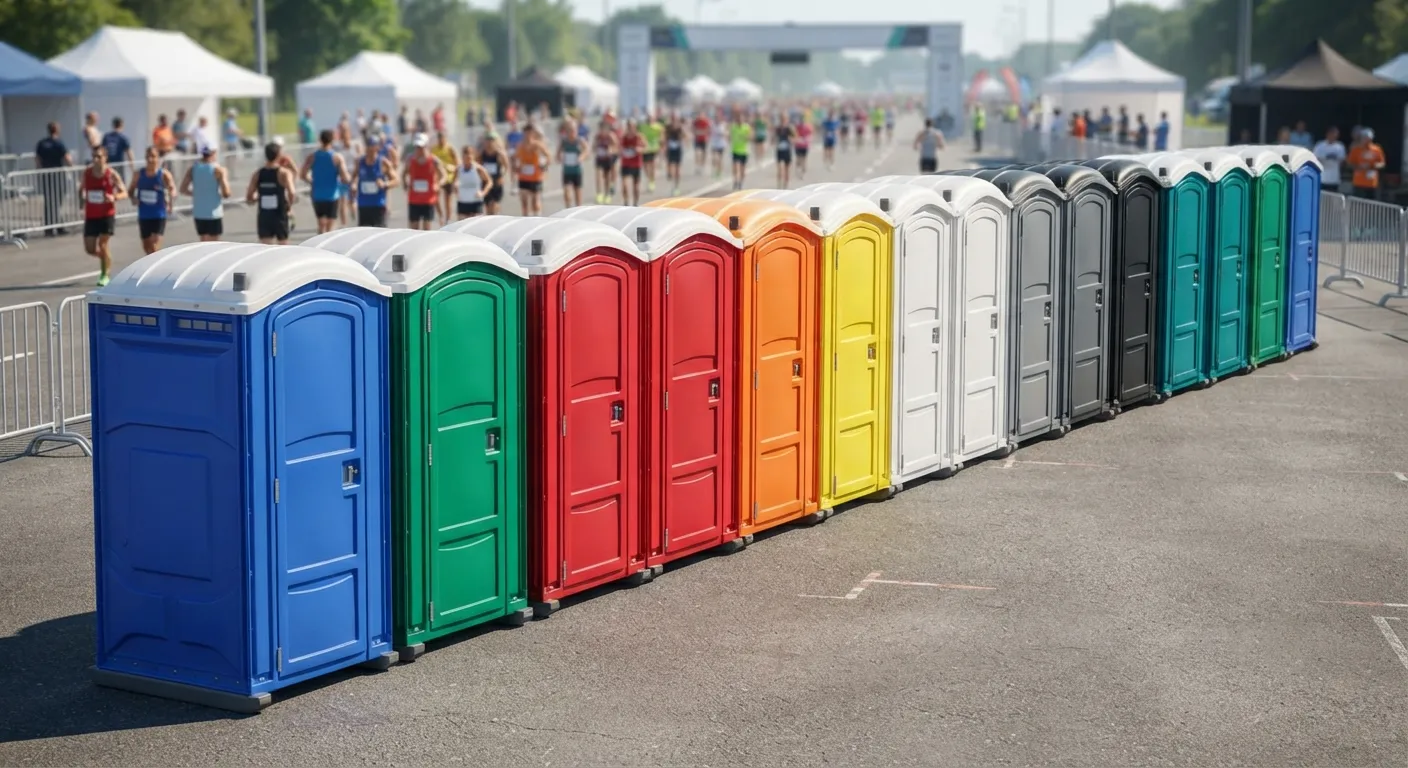
Start with runners per unit, then adjust for weather and course layout. How Many Porta Potties Do I Need in Charleston, SC walks through the math in detail, but the short version: races cluster units at the start corral, thin them out along the route, then load up again at the finish chute where runners linger. A standard porta potty rental runs from the day table up through event pricing, and race organizers usually book under the event rate since a marathon is a single-day, high-traffic booking rather than a weekly job. Courses that loop through downtown Charleston need units placed where a service truck can actually reach them between waves, which means working with the route map early, not the week of the race. If the course crosses into Hanahan, 9.5 miles north, or loops toward James Island, 9.7 miles south, we plan servicing runs around road closures so trucks aren't stuck outside the safety perimeter when a unit needs a mid-race pump. For races with wheelchair divisions or adaptive athletes, ADA Accessible Porta Potty units need to sit on stable, firm, slip-resistant ground per ADA Standards section 302.1, with a 60 inch turning circle per ADA Standards section 304.3.1 clear of tents, cabling and signage. ADA Standards section 213.2 sets the baseline: when single-user units are clustered, at least 5 percent must be accessible, never fewer than one. That is a floor for a race start line, not a ceiling.
What does race restroom rental cost in Charleston?
| unit | duration | typical price |
|---|---|---|
| standard | event | $400 |
| ada | day | $230 |
| deluxe | day | $300 |
| trailer | event | $3,500 |
| service_fee | day | $175 |
Event-day standard units run higher than a weekday job site rental because of tight delivery windows and same-day pickup. Porta Potty Rental Cost in Charleston, SC breaks down what drives the number up or down, and Porta Potty Rental Per Day in Charleston, SC is worth checking if your race is a shorter fun run rather than a full marathon. Bigger races with VIP tents or a finish line hospitality area often add a restroom trailer rental instead of stacking more standard units; a 4 Stall Restroom Trailer handles sponsor tents well, while an 8 Stall Restroom Trailer fits a finish festival with beer garden and vendor rows. Delivery fees scale with distance and timing too, so a course finishing near Sullivan's Island, 11.7 miles southeast, costs differently to service than one that stays inside Charleston proper. If your event runs across a whole weekend, weekend rates on trailers and standard units apply instead of the day rate, and that number sits well above a single day's cost, so book the correct duration up front rather than extending a day rental after the fact.
How to brace a temporary power pole for a race site?
Timing chips, PA systems and finish-line arches all need power, and that power usually comes from a temporary power pole staked near the finish chute or start corral. Bracing matters because race day brings crowds, cables underfoot and wind off open fields, and a pole that shifts mid-race can drop timing equipment right when results matter most. The pole needs a stable base set below grade or ballasted with weighted feet, guy-wired where the ground won't hold a post, and positioned clear of the runner corridor so nobody clips it sprinting to the finish. Pair it with GFCI protection under OSHA 1926.404(b)(1)(ii) since race sites run mixed cabling near restrooms and wash stations in wet grass or damp pavement. Route cable runs along fence lines rather than across walkways, and use a temporary fence rental or crowd control barrier rental to keep spectators off the cable path entirely. For lighting a pre-dawn start corral, a light tower rental sits on its own ballasted base and doesn't need bracing the same way a pole does, but keep both clear of the runner lanes. Charleston races that start before sunrise lean on light towers at the corral and power poles at the finish, run separately so one failure doesn't take down both systems.
Race organizers also need handwashing near food and hydration stations. A handwashing station rental satisfies OSHA 1926.51(a)(1)'s requirement for potable water at the site, and stations must carry soap and towels or a hand drying device per 29 CFR 1910.141(d)(2), not hand sanitizer alone. If your race route crosses onto a farm or agricultural venue, check Farm and Agricultural Restrooms in Charleston, SC for field sanitation rules under OSHA 1928.110. Placement along the actual course matters more than raw unit count, so review the porta potty placement guide before finalizing your map, and use Marathon and Race Restrooms in Charleston, SC as your planning hub alongside Event Restroom Rental in Charleston, SC for combined logistics.
How many restrooms do I need at the finish line?
Finish lines see the heaviest cluster of any point on the course, since finishers linger for water, medals and photos. Plan for a mixed bank of standard units and at least one ADA unit per ADA Standards section 213.2, plus a trailer if you're running a post-race festival.
Do we need accessible units even if no wheelchair racers are registered?
Yes. ADA Standards section 213.2 requires at least one accessible unit whenever single-user toilets are clustered, regardless of registered division. Spectators, volunteers and staff may need it too, so don't skip it based on the runner roster alone.
Can restrooms be serviced mid-race without disrupting the course?
Yes, if service trucks have a route planned around road closures in advance. Charleston Porta Pros coordinates pump-out timing with the race director's closure map so trucks reach start, aid station and finish units without crossing an active runner lane.
What's the difference between a standard unit and a trailer for a race?
A standard porta potty rental is a single-stall unit around 44 by 48 inches on the ground, best for course-side spacing. A restroom trailer rental offers multiple stalls, sinks and better comfort, suited to start/finish hubs rather than mile markers.
How far in advance should we book race restrooms?
Book as soon as your course map and expected field size are set, since event-day trailers and ADA units book out fastest. Races with tight downtown Charleston closures especially need lead time to lock delivery windows before permits finalize.

Next step
Get a delivery date
Tell us the address, the dates and the headcount. We size the order and confirm the route.